A patch release tells you a fix exists. It does not tell you whether anyone has installed it. On 18 November 2026, nginx shipped fixes for NGINX2Root, five flaws that can each give an attacker remote code execution without logging in. The day after, we started counting how many internet-facing nginx services still run an affected version, and we will keep counting.
The result is a live dashboard, open to anyone: NGINX2Root on Modat Data Dashboards.
Day One: 14 Million Affected, Few Fixed
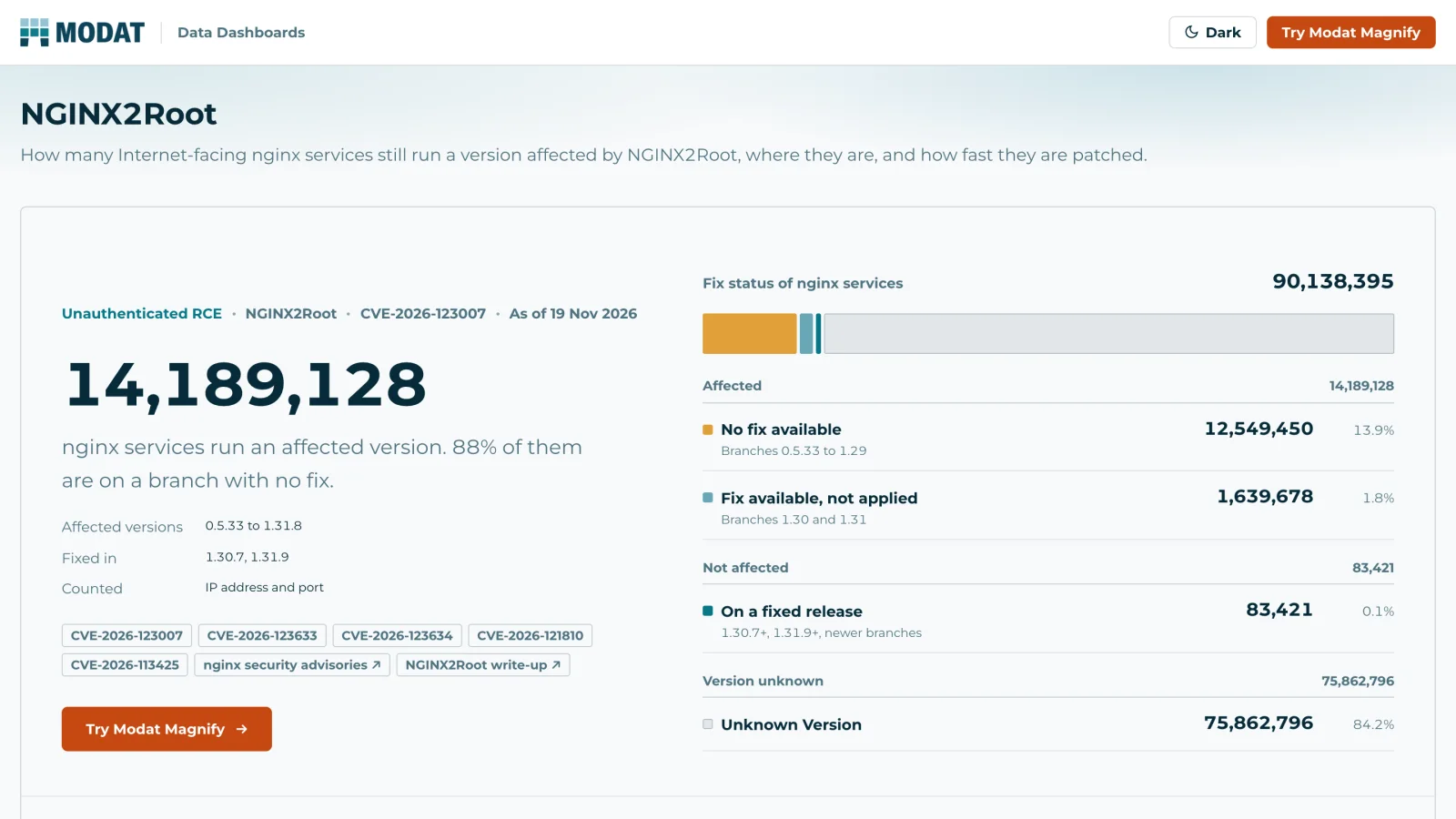
On 19 November 2026, Modat saw 90,138,395 nginx services on the internet. We count each IP address and port as one service, and the dashboard shows counts only, never IP addresses. The 84.2% of services that report no version are not in the figures below. Of those that do report one:
- 14,189,128 run an affected version. That is 99.4% of every nginx service that reports a version.
- 12,549,450 of them, 88%, are on branches 0.5.33 to 1.29, where nginx will ship no fix. Getting safe means moving to a newer branch, not installing a patch.
- 1,639,678 are on 1.30 or 1.31, where the fix exists and has not been applied yet.
- 83,421 are on a fixed release.
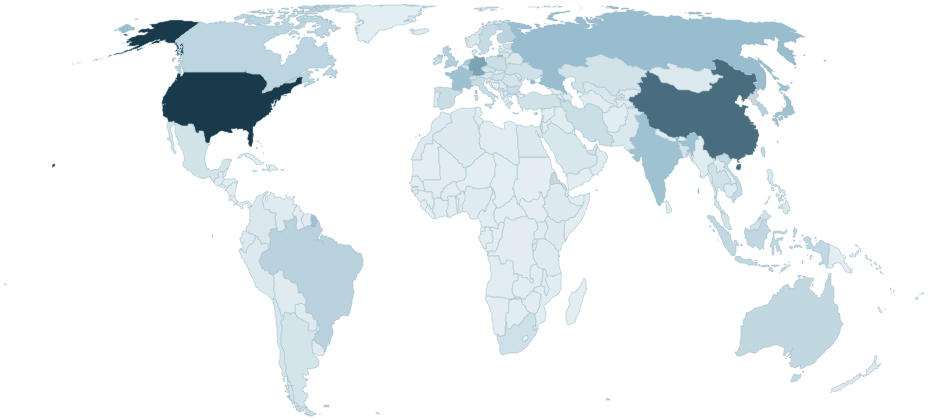
Across all affected services, 0.6% is on a fixed release. On the two branches that have a fix, 1.30 and 1.31, it is 4.7% so far. The United States has the most affected services, with 3.3 million, followed by China with 2.1 million, and Hong Kong and Germany with 1.1 million each.
One finding needs care. The three most common affected versions on the dashboard, 1.24.0, 1.18.0 and 1.22.1, are the versions Ubuntu 24.04, Ubuntu 22.04 and Debian 12 ship by default. Those distributions can backport a fix into their own package without changing the version number nginx reports. From the outside, a patched Ubuntu server and an unpatched one look the same, so some of the services in the “no fix” group may already be safe. The dashboard counts what services report. It cannot see inside the package.
A version is also not proof that a service can be exploited. That depends on how the server is set up too, for example whether HTTP/2 is turned on. The figures show how many services run an affected version, not how many can be attacked.
The Flaws in Brief
Together, the five flaws affect every nginx version from 0.5.33 to 1.31.8. They are fixed in 1.30.7 and 1.31.9, and rated 9.2 (CVSS 4.0). Which one reaches a server depends on how it is configured:
| CVE | Affected when nginx uses | Stopped by turning HTTP/2 off? |
|---|---|---|
| CVE-2026-123007 | HTTP/2 | Yes |
| CVE-2026-123633 | HTTP/2, forwarding requests to a backend server | Yes |
| CVE-2026-123634 | The DNS resolver, with subrequests such as mirror | No |
| CVE-2026-121810 | HTTP/3, forwarding requests to a backend server | No |
| CVE-2026-113425 | The mail proxy with auth_http | No |
The name comes from a sixth flaw, in the Linux kernel. Combined with any of the five, it gives an attacker root access: full control of the server, not just of nginx. As of 19 November 2026, no attacks using these flaws have been reported.
What to Do
- On 1.30 or 1.31: upgrade to 1.30.7 or 1.31.9, then restart nginx. Reloading the configuration does not replace the running program.
- On anything older: move to a fixed 1.30 or 1.31 release. If nginx came from your Linux distribution, compare the full package version with the distribution’s security advisory to see whether the fix has been backported.
- If you cannot update yet: turning HTTP/2 off blocks two of the five flaws. It does not block the other three.
For the technical detail on each flaw, see the nginx security advisories.
Follow It Live
The first day sets the baseline. What matters is how far the number of fixed services climbs in the weeks after. Open the NGINX2Root dashboard to follow it branch by branch and country by country.
To check whether your own organisation is exposed, look up your domains and networks in Modat Magnify.