Java does not announce itself. A web server tells the internet what it is and often which version it runs. Java sits underneath the application, out of sight. So when Java4Shell (CVE-2026-114938) was disclosed, the question “how many servers are exposed?” had no direct answer.
We took the route that does work: count the internet-facing hosts that run well-known products built on Java, and read from each product’s version which Java that release needs. That narrows it down, but it is not the same as seeing the Java itself. The result is a live dashboard, open to anyone: Java4Shell on Modat Data Dashboards.
Day One: 90,407 Hosts in Scope
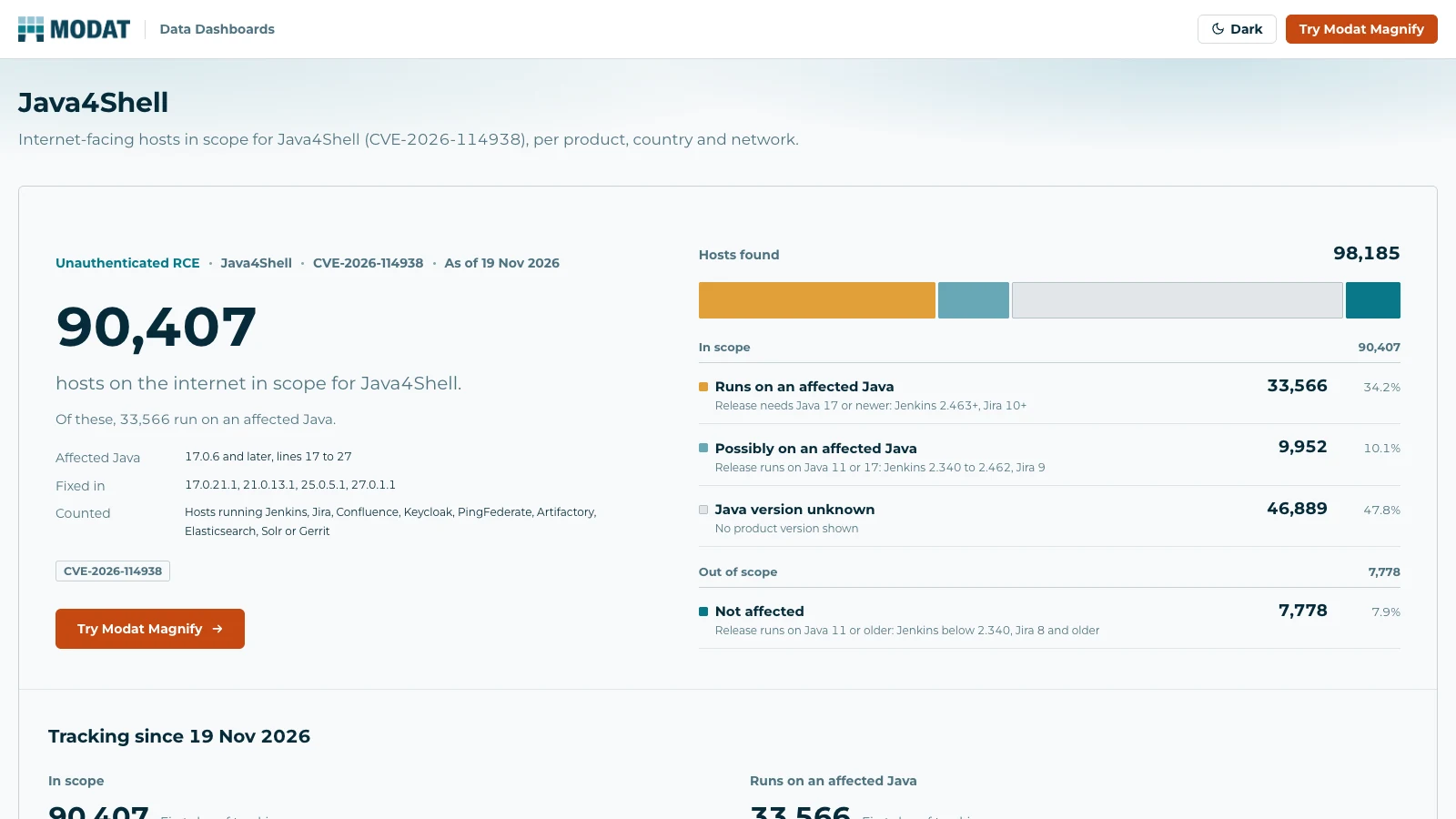
On 19 November 2026, Modat saw 98,185 internet-facing hosts running Jenkins, Jira, Confluence, Keycloak, PingFederate, Artifactory, Elasticsearch, Solr or Gerrit. In that total, and in the number in scope, each host is counted once, also when it runs more than one of these products. The lines below it are counted per product, so a host that runs two of them can appear in more than one line. Of those hosts:
- 90,407 are in scope for Java4Shell.
- 33,566 run a product release that needs Java 17 or newer, such as Jenkins 2.463 and later or Jira 10 and later. These releases cannot start on anything older than Java 17, so these hosts run Java 17, 21 or 25, the lines that contain the flaw. Whether their Java is an affected build or a fixed one cannot be seen.
- 9,952 run a release that works on Java 11 or on Java 17, such as Jenkins 2.340 to 2.462 or Jira 9. They could be on either.
- 46,889 run a product where the version is not visible or does not tell us its Java.
- 7,778 are out of scope: their release only runs on Java 11 or older, which is not listed as affected.
Jenkins is by far the largest group, with 52,968 hosts in scope. Elasticsearch follows with 13,692, Keycloak with 6,474, Solr with 5,486, Jira with 5,076, Confluence with 4,733, PingFederate with 2,530, Gerrit with 644 and Artifactory with 69. For Elasticsearch, Solr and Gerrit, an attack needs a login first.
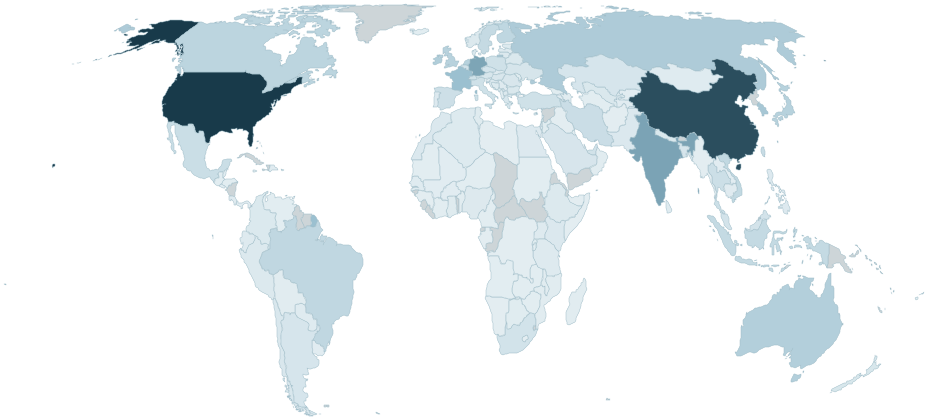
The United States has the most hosts in scope, with 21,723, followed by China with 18,471, India with 7,390 and Germany with 7,241. The hosts are concentrated: the 15 largest networks hold 67% of them.
What the Numbers Do Not Say
We do not see which Java a host runs, apart from a few hundred that show it in a banner. These products do not show their Java version to the internet, so none of these figures says that a host is on an affected Java, let alone that it can be attacked. What we can see is the product and, for Jenkins and Jira, its version. From there, three things stay out of sight:
- The exact Java build. A release that needs Java 17 or newer may be running an affected build, a fixed build, or one of the early Java 17 builds (17.0.0 to 17.0.5) that never had the flaw. From the outside they look the same.
- The processor. The flaw only triggers on CPUs with a specific instruction set, AVX-512 VBMI.
- The path to the flaw. An attacker’s input has to reach Java’s Base64 decoder, and the decoder has to have been in use long enough for Java to switch to its optimised code.
So the figures show how many hosts are in scope and have to be checked by the people who run them, not how many are affected or can be exploited.
The Flaw in Brief
Java4Shell is a memory-corruption flaw in the Base64 decoder of OpenJDK, the most widely used Java runtime. Base64 is everywhere in web applications: in logins, file uploads and network messages. A malformed input can make the decoder write past the end of its memory, which an attacker can turn into reading memory or running code. It is rated 9.2 (CVSS 4.0).
- Affected: OpenJDK 17.0.6 and later, on Java 17, 21, 25 and 27. Oracle also lists Java SE 8u511b33-perf.
- Fixed in: 17.0.21.1, 21.0.13.1, 25.0.5.1 and 27.0.1.1.
- Not listed as affected: Java 8 and Java 11, apart from that one Oracle build. Java 17.0.0 to 17.0.5 came before the flaw.
What to Do
- On Java 17, 21, 25 or 27: update Java to the fixed build for your line, then restart the application so it runs on the new Java.
- On Java 8 or 11: not listed as affected, except Oracle Java SE 8u511b33-perf. Check your vendor’s advisory.
- Check which Java your product really uses. Some products ship with their own Java, so updating the system’s Java does not always update the one the product runs on. Check the vendor’s advisory for your product.
Follow It Live
The dashboard tracks in-scope hosts from 19 November 2026 onwards, per product, country and network. Java updates do not change these counts: a host that installs the fixed Java looks the same from the outside. The counts move only when hosts change product release or go offline. Open the Java4Shell dashboard.
To check whether your own organisation is exposed, look up your domains and networks in Modat Magnify.