
Every phishing campaign and every exploited system leaves something behind on the public internet. The question is whether anyone reads those traces in time.
Preparation Leaves a Trace
Attacks rarely start with the first malicious action. Adversaries often set up infrastructure first, which the MITRE ATT&CK framework calls Resource Development. Some of this setup happens in public, like registering domains, issuing certificates, configuring servers, and changes in how services behave. Alone, these signs may not mean much, but when you look at what a system is, how it connects, and how it changes, you can spot when infrastructure is being prepared. These traces are not intent themselves, but they give analysts something to check before an attack is confirmed.
From Visibility to Understanding
Seeing that something exists on the internet is not the same as understanding it. A newly registered domain may be harmless or the first step in an impersonation campaign. An exposed remote-access service may be well managed or forgotten. The difference is context, and that context is what Internet Intelligence, more specifically Internet Infrastructure Intelligence, provides.
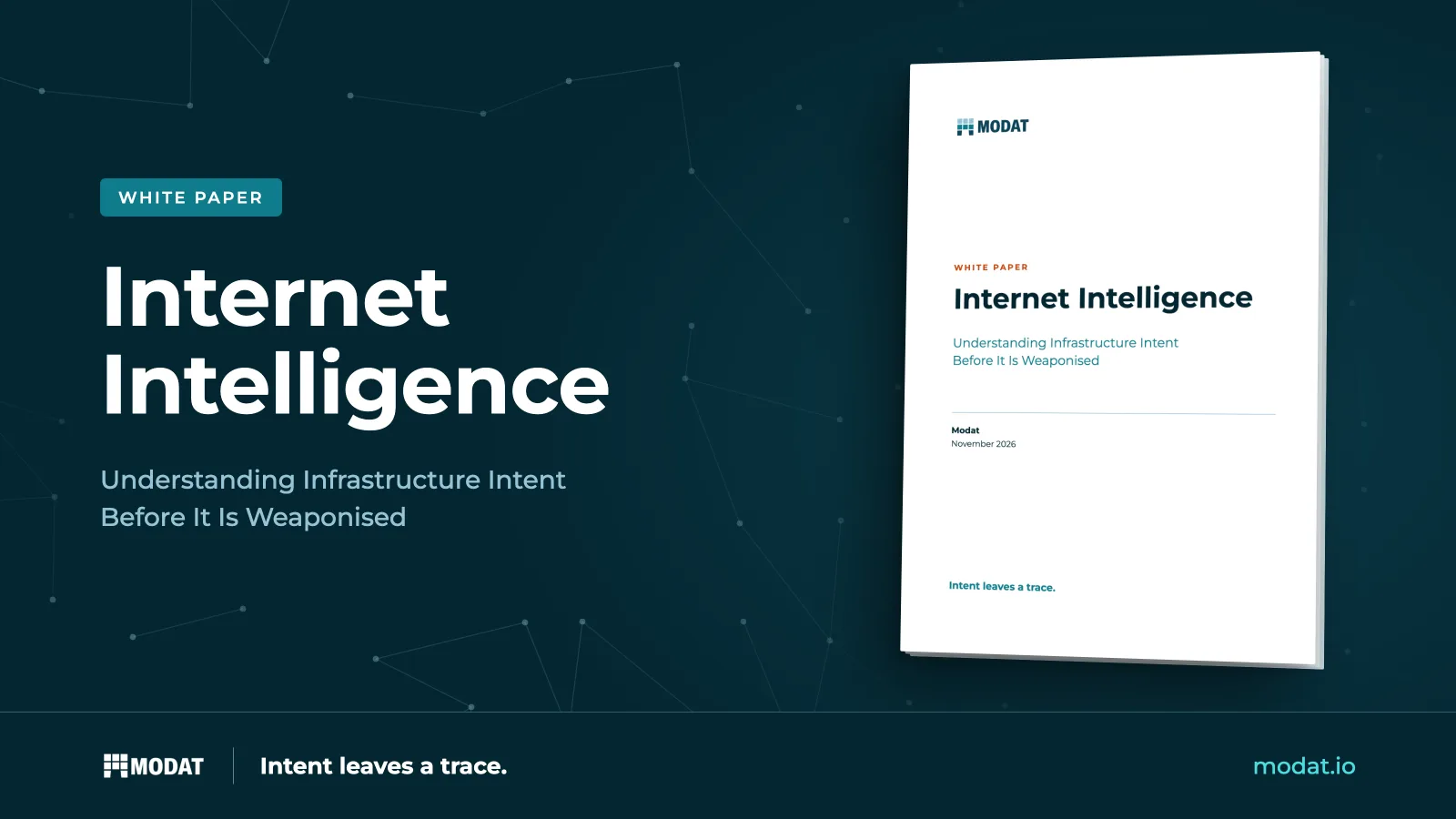
The white paper sets out five principles that turn observations into that context.
- Observation. Continuously mapping what is reachable from the internet.
- Identity and relationships. Profiling what each system is and which systems belong together.
- History and change. Tracking how infrastructure behaves over time, and who controlled it at each point.
- Interpretation. Inferring likely intent from evidence, with a stated level of confidence.
- Action. People decide what to do, with AI agents preparing the evidence.
Built for People and Agents
AI agents can search infrastructure, enrich indicators, and monitor change at a scale that is difficult to achieve manually. But an agent working with fragmented or outdated data only produces faster answers, not better ones. The white paper explains why agents need data that is current, historical, structured, and connected, and why decisions about blocking, reporting, or escalating should stay with people.
Knowing the Limits
External evidence has limits, and the white paper is explicit about them. Coverage is never complete. A system that is reachable is not automatically at risk. And infrastructure that looks similar to malicious infrastructure is not necessarily malicious. Internet Intelligence works best combined with internal telemetry and human judgement, and findings about exposed systems should always be shared responsibly.
Download the Full White Paper
The white paper covers:
- why earlier understanding matters, based on current industry data
- how Internet Intelligence relates to EASM, threat intelligence feeds, vulnerability scanning, and SIEM
- the five principles of the Internet Intelligence model
- what AI agents need from infrastructure data, and where people stay in charge
- illustrative scenarios for banks, security vendors, and NCSCs, CERTs, and CSIRTs, including the relevance of DORA and NIS2
- the limits of external evidence and how to use it responsibly